




 Back to list

In an environment where digital projects are multiplying and Resources are under pressure, project planning can no longer be reduced to a simple sequence of tasks or activities. It has become a strategic method of global management, at the crossroads of coordination, arbitration and governance.
Planning today means identifying sometimes conflicting priorities, anticipating workload conflicts, securing high-value deliverables, while remaining capable of reacting to the unexpected. It means building a living framework that articulates strategy, execution, real capacity and business trajectory. For the project manager, each stage of the planning process becomes a lever for managing, steering and organizing collective work.
With this in mind, software solutions such as Abraxio enable us to go beyond the traditional sequential logic, by providing a more transversal, more realistic and more legible project management system, thanks to planning management tools adapted to each type of project.
1. Why plan Projects?
Planning is often underestimated, reduced to a preparatory stage “before the real Projects”. Yet it is a lever for transformation, credibility and coordination.
Before even thinking about execution, planning serves to align the stakeholders on the same course by respecting a working method:
- What are the objectives?
- What are the key deliverables?
- What’s the target date?
- What are the constraints?
A clear schedule facilitates exchanges with business units, reassures sponsors and provides an anchor for project steering and management. Projects don’t take place in a vacuum. In a CIO portfolio, you have to choose between several, sometimes competing, projects.
Planning is therefore also a tool for arbitration:
- Can we really launch this project now?
- What’s the impact if it’s delayed?
- What value is delivered when?
Planning then becomes a decision-making tool, especially when coupled with a vision of capacity.
Projects regularly fail due to poor planning – unclear objectives, ill-defined scope, lack of coordination or mismanagement of resources, no clear working method, and so on. Rigorous planning considerably reduces the risk of drift, by structuring the key stages of the project from the outset.
2. How to define project objectives and scope?
It all starts with clarifying the “why”:
- What is the business need or strategic challenge?
- What concrete results are expected?
- Which irritants need to be treated?
- What are the project’s limits?
Defining scope is not just about saying what you’re going to do, it’s also about saying what you won’t do. This avoids scope creep and unrealistic expectations. This step ensures structured management right from the start of the project, by setting a clear course around which Teams can organize their work, the tools to be used, and the distribution of tasks. Adherence to this method is essential, as it enables us to identify the processes inherent in the Projects.
An effective Projects sheet doesn’t just tick boxes. It must serve as a common reference, integrated into a shared, contextualized space. There are many different ways of creating a Projects sheet. Certain tools can help structure these elements, by proposing templates for different types of Projects (regulatory, business, technical redesign…).
Tip : defining the scope of a project is one of the 5 fundamental dimensions of project planning, along with Resources, Time, Quality and Risks (in particular doing or not doing the project). This is a critical step in Project management, and one that must not be skipped.
3. How to identify tasks, milestones and milestones?
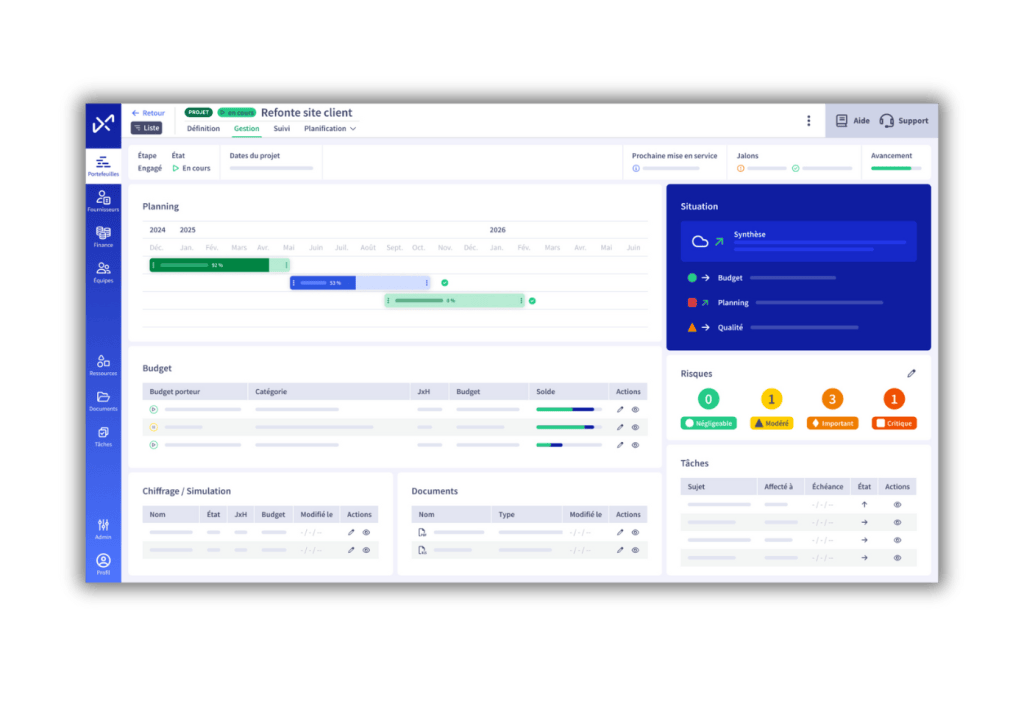
Once the objectives have been defined, the intention must be translated into a logical sequence of actions. This is the purpose of the WBS (Work Breakdown Structure), which enables a project to be broken down into smaller, more manageable elements, with the aim of clarifying the scope, facilitating the planning of the various lots, estimating the costs and resources to be assigned, and monitoring progress.
This involves :
- Break down Projects into functional or technical stages,
- Identify milestones: validations, commitments, key decisions,
- Distinguish between critical, conditioning or high-impact tasks or activities.
The level of detail needs to be adjusted: a Gantt chart diagram is too full, making it difficult to read. Conversely, a plan that is too abstract prevents effective management. The aim is to build a clear, steerable, mobilizing Projects schedule, with method and respect for key milestones.
Each task must be clearly defined: who is responsible for it, for when, and in what order. This is the basis for collaborative working and Tracking. Modeling dependencies – between tasks, Projects or Teams – is a useful aspect of management.
Tools such as Gantt charts, Kanbans and dynamic Roadmaps make it easy to visualize progress, workloads, delays and critical links in project management. These planning methods have already proved their worth in scheduling key stages of a Projects project in a way that is useful to all parties involved.
4. How to align Projects ambition and actual capacity? The key to responsible planning
In many CIOthe main point of friction between planning and reality is the gap between project ambitions and the actual capacity of Resources, including the Budgets allocated to the project and the size of Teams.
It’s not enough to assess a theoretical workload. But how? You need to cross-reference this estimate with :
- Resources available at each stage,
- Other projects that compete with or use the same profiles,
- Governance decisions on short-term priorities.
Visit capacity planning becomes a key element of any serious planning method. It transforms a static plan into a decision-making tool, capable of simulating arbitration scenarios.
Some project management tools can offer workload analysis, assignment and scenario simulation functions, which help to calibrate tasks according to actual availability, and adjust the overall schedule.
5. How to draw up a timetable with realistic milestones?
Once the tasks have been identified and the Resources estimated, we can build the Projects schedule.
- It is based on significant milestones, standardized and integrated into a logical trajectory,
- It takes into account Availability (vacations, closing periods, operational workloads),
- It leaves room for flexibility, especially when it comes to absorbing the unexpected.
Planning is a framework for anticipation, not a rigid promise, and should be simple and collaborative to update. It is a dynamic management tool, providing stakeholders with a clear view of milestones, commitments and forthcoming decisions.
6. How can you adjust your planning without losing control?
Once a project has been launched, planning must live on. A slipping milestone, an unavailable resource, a new business requirement: deviations are inevitable. A good schedule must integrate this evolutionary dimension right from the start.
It is therefore crucial to implement Agility management based on Milestones and weak signals. This enables :
- identify incipient delays in project management (remaining-to-do variances, abnormal consumption),
- readjust locally without calling everything into question,
- synchronize corrective actions with other projects in the portfolio.
Tracking a project should not be seen as a form of control, but as a tool for collective adaptation, provided you have the right KPIs and a multi-project vision consolidated in a schedule.
The aim is not to track tasks for their own sake, but to maintain consistency between the plan, Resources and business objectives.
Integrating these elements into management tools helps simplify arbitration, avoid silent drift, and steer a portfolio as a whole. All with method and rigor, for optimal project planning.
7. Gantt, dynamic steering and tools for lively planning
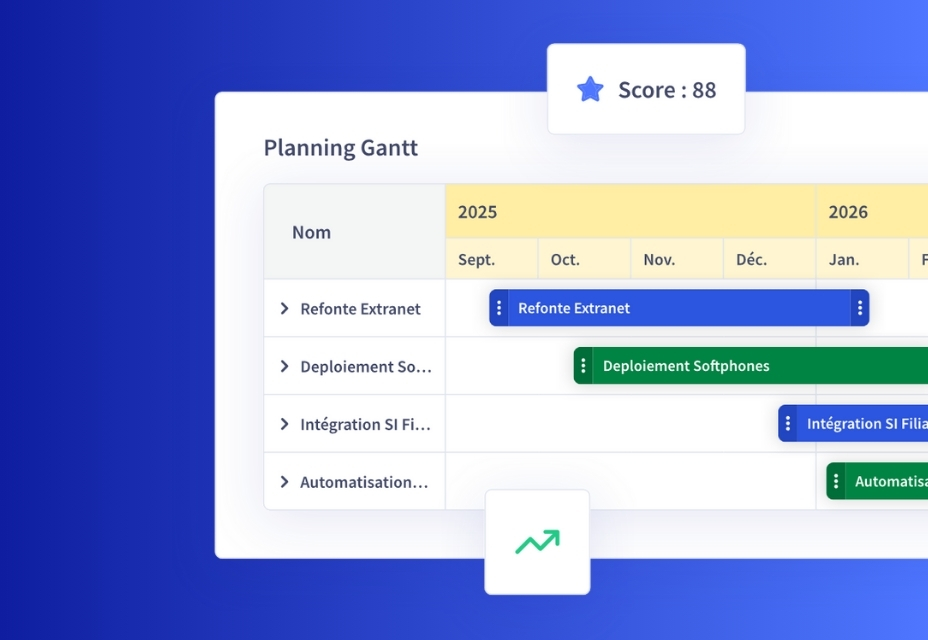
The Gantt chart remains one of the most widely used planning and project management tools. It provides a structured view of sequences, key dates, dependencies and tasks.
But it’s not enough on its own. It must be integrated into a complete Project management platform, capable of :
- navigate between macro and micro views,
- automatically consolidate Projects data,
- display Workloads, Alerts and Milestones in a shared interface.
A good management tool allows you to navigate between different levels of granularity: strategic roadmap, detailed plan, capacity by profile. This is where solutions like Abraxio really come into their own: they provide a consolidated, real-time vision that can be updated and used by both Projects Teams and management.
8. How to communicate planning effectively?
Communication is an all too often underestimated link in Project management. A good schedule must also be easy to read, understand and share.
This requires :
- adapt formats to target audiences (management teams, business units, field teams),
- automate the distribution of updates (milestones tables, diagrams, friezes, etc.),
- value results and arbitrations in clear language.
A good planning tool must therefore offer multiple reporting capabilities, without overloading Teams with manual reporting tasks.
A tool like Abraxio can be used to prioritize and group lots / phases / activities. Thus, depending on the level presented, a single schedule is maintained by the project manager, but its presentation is adapted according to the audiences concerned.
Summary
Effective Projects planning doesn’t mean producing a diagram or filling in an Excel file. It’s about steering, structuring and coordinating, using a rigorous, tool-based and collaborative project management method, in line with corporate processes.
This involves following 7 key steps:
- Clearly define objectives and scope,
- Cleverly divide the stages,
- Estimate and cross-reference workloads with actual capacity ,
- Allocate resources taking into account trade-offs,
- Steer by Milestones, with simple but regular Tracking,
- Communicate appropriately to different audiences,
- Equip the approach with appropriate management tools.
Effective planning is a structuring act, at the crossroads of strategy and operations. It determines the success of Projects, the alignment of Teams, and the organization’s ability to deliver value reliably and continuously.