




 Retour à la liste

Traditional project management methods, also known as sequential or predictive, organize the project in linear phases, with each stage depending on the previous one. They are based on a strict predictive framework: the project’s Statement of Work (SOW) is defined upstream and validated before any work is carried out. This model has emerged in the industrial (manufacturing, construction) and military sectors, where in-process modifications are very costly.
Today, these approaches are aimed at Projects where requirements are well understood and stable from the outset. In particular, they are aimed at organizations requiring a high degree of control and rigorous traceability (e.g. CIOs of large companies, the banking or defense sectors).
Waterfall cycle
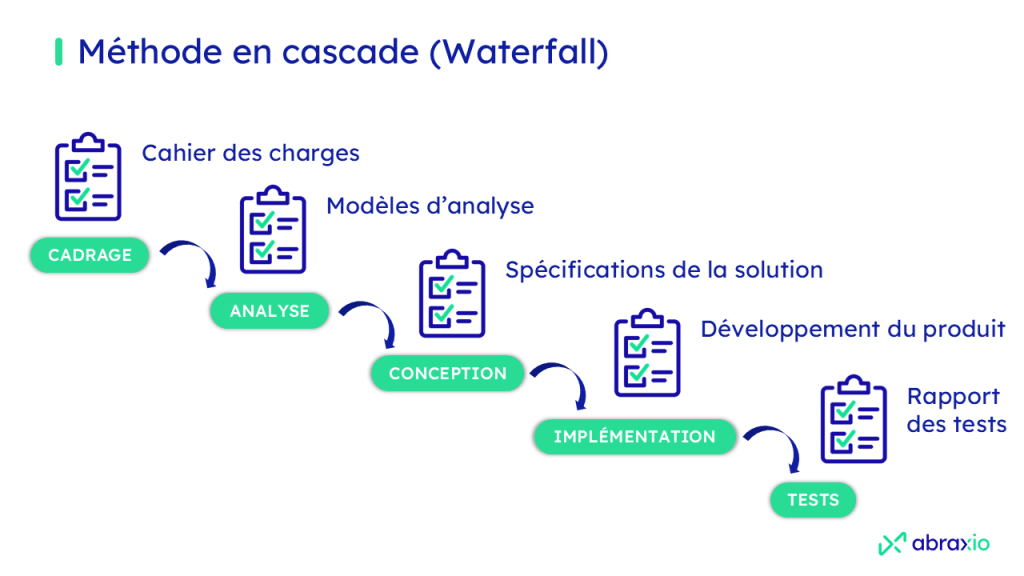
The Waterfall method is a linear, sequential approach to Projects. It divides the lifecycle into distinct phases (e.g. requirements expression, functional design, realization, testing, deployment, maintenance).
Each phase produces key deliverables: for example, a Statement of Work (SOW) at the end of the Requirements phase, specifications and design documents after the Analysis/Design phase, the software developed during the Realization phase, and test reports during the Validation phase.
Management is highly structured: progress is generally monitored using a Gantt chart with milestones and formal phase reviews. Resources (time, Budgets, Teams) are allocated in a predefined way, and each phase requires validated Deliverables before proceeding.
What are the advantages and disadvantages of Waterfall?
The main advantage of the Waterfall model is its clear, detailed planning. From the outset, it offers a precise vision of planning and Resources, facilitating Teams’ commitment to well-defined objectives. Extensive documentation (Statement of Work (SOW), specifications, test reports) guarantees traceability and reproducible project knowledge. This framework is ideal for Projects with stable requirements that are perfectly identified in advance.
On the other hand, this rigidity implies little room for change: once a phase has been validated, it’s expensive to go back to it. The Waterfall model suffers from a lack of flexibility, and does not tolerate major changes along the way. If an activity is delayed or unforeseen, the impact is felt throughout the entire schedule. What’s more, quality assurance comes into play rather late, at the final testing stage: an error detected late can lead to complex corrections.
V-cycle
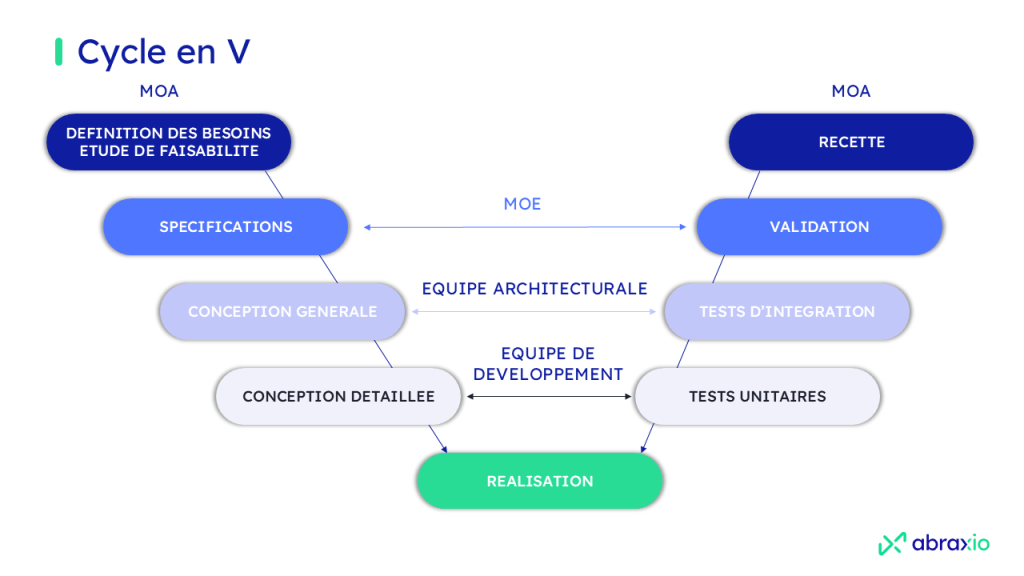
The V-cycle is a sequential model that extends the cascade by reinforcing validation at each stage. Each design phase (top-down) is linked to a corresponding test phase (bottom-up).
For example, unit tests are carried out after detailed module design, integration tests after complete definition of the architecture, and so on. The V-cycle details the key phases (preliminary study, specifications, design, implementation, unit/integration testing, final validation) , with particular emphasis on validation flows.
Deliverables include specification and validation documents for each milestone. As with Waterfall, a Gantt chart is often used to steer progress, but the emphasis is on compliance between each design and the associated tests.
What are the advantages and disadvantages of the V-cycle?
The principles are the fundamental rules that determine whether a Project is truly PRINCE2-compliant. They are not optional:
This model is recommended when requirements are very clear and stable, and when high quality standards or business norms must be respected. Continuous validation gives Teams a clear view of quality at every stage.
On the other hand, like the waterfall, the V-cycle remains very rigid. Changes to specifications are difficult to absorb, as any redefinition requires a revision of the downstream test phases. This methodology is less suited to changing environments: its “tunnel effect” means long iterations before deviations are detected.
It also requires extensive documentation and formalized management (phase reviews, committees), which can make the process more cumbersome for certain Projects.
PRINCE2 Method
PRINCE2 (PRojects IN Controlled Environments) is a highly structured method for managing Projects, first developed in the UK in 1996 and now used worldwide. Contrary to a simple sequential model, PRINCE2 defines a complete reference framework comprising 7 principles, 7 processes and 7 themes (practices) covering the entire life cycle.
What are the 7 PRINCE2 principles?
However, the 2026 trend shows a clear trend: methodological alignment is becoming a performance lever. The adoption of common frameworks – be they Agility, Project portfolio, hybrid models, or in-house repositories – will accelerate maturity, facilitate handovers, strengthen inter-team communication, and make digital data-based management more reliable, thereby boosting productivity.
- Ongoing project justification: a project only makes sense if it remains economically viable throughout its life.
- Learning from experience: each project capitalizes on past lessons and documents what has been learned.
- Defined roles and responsibilities: each player knows his or her scope of action and contribution to collective success.
- Step-by-step management: Projects are broken down into controlled phases, each of which results in a decision to continue.
- Management by exception: governance is based on tolerances (cost, deadline, scope, quality, risk), enabling steering without micromanagement.
- Focus on products: priority is given to the expected deliverables and their quality, rather than to the simple execution of tasks.
- Adaptation to the environment: PRINCE2 must be adapted to the culture, size and complexity of the Projects.
How do the 7 themes govern the PRINCE2 method?
Themes structure project management. They define what needs to be controlled to ensure consistency and overall quality:
- Business Case: ensuring the economic justification and added value of Projects.
- Organization: specify roles, governance structure and decision-making circuits.
- Quality: formalize criteria, standards and validation processes for deliverables.
- Plans: define the Roadmap, Resources and Milestones.
- Manage project risks: anticipate uncertainties and manage hazards.
- Change: managing change requests and their impact.
- Progress: monitor progress, produce performance reports and decide on follow-up action.
How do the 7 PRINCE2 processes punctuate the Projects lifecycle?
Processes describe the dynamics of Projects according to PRINCE2 – from start to finish. Each process corresponds to a key stage and specific responsibilities:
- Starting up a Project: assessing feasibility and defining the broad outlines before committing to a project.
- Initiating a Project: building the Project Initiation Documentation.
- Directing a Project: to enable the Steering committee to decide, validate and arbitrate the major orientations.
- Controlling a Stage: monitor operational progress and manage deviations on a daily basis.
- Managing Product Delivery: organize and supervise the production of deliverables.
- Managing a Stage Boundary: preparing the next phase and validating intermediate deliverables.
- Closing a Project: check compliance, measure benefits and formalize lessons learned.
The approach is product-driven : planning is based on the deliverables to be achieved, and the project is broken down into manageable stages. At each stage (start-up, milestone control, deliveries, closure, etc.), steering committees validate progress, ensuring continuous monitoring.
What are the advantages and disadvantages of PRINCE2?
PRINCE2 offers the advantage of rigorous control and strong governance. This method requires permanent justification of the project (business case) and organizes the management of risks and changes. Its aim is to give Teams better control over Resources, mitigate risks and analyze project profitability.
In particular, this formalism enables Budgets to be controlled and Milestones to be met. This method is ideal for large-scale or high-stakes Projects (e.g. in finance or public procurement) where compliance and communication between players are paramount.
On the other hand, PRINCE2 implies an abundance of documentation and a sometimes cumbersome formal framework. A multitude of registers must be kept (business cases, risk registers, logbooks, etc.) and numerous interim reports written. This often-criticized documentation requirement can be perceived as excessive, slowing down responsiveness. What’s more, PRINCE2 applies the same standard processes to all Projects, making it less flexible.
Finally, mastering PRINCE2 generally requires dedicated training: without prior knowledge of this methodology, it is difficult to benefit from it effectively.
In short, PRINCE2 is a powerful framework for complex Projects, but can seem bureaucratic if the organization lacks the maturity to implement it.
Other traditional approaches: PERT/CPM

PERT/CPM methods are planning and scheduling techniques, often used in conjunction with phasing. The PERT diagram (” Program Evaluation and Review Technique “) is a visual tool that models a Projects as a network of tasks. Each task is estimated in terms of duration (three estimates: optimistic, most probable, pessimistic in PERT), then linked to dependent tasks.
The PERT method helps to identify the critical path, i.e. the sequence of tasks that determines the minimum duration of the project.
The CPM(Critical Path Method) works on the same principle, using a fixed duration per task.
These approaches produce planning deliverables: PERT network, associated schedule, list of tasks with margins. Management then focuses on compliance with the optimized schedule: progress on each task is monitored, the critical path updated and resources reallocated if necessary.
PERT/CPM are used in particular for complex Projects with many parallel tasks, where time control is crucial.
What are the advantages and disadvantages of PERT/CPM?
PERT/CPM diagrams provide a valuable overview. They clearly show the dependencies between tasks and the critical path of the project, making it possible toaccurately estimate duration and manage margins.
Using three time estimates (optimistic, most likely, pessimistic), PERT refines the overall estimate. Project managers can thus identify tasks that can be delayed without affecting the final date.
On the other hand, these methods require reliable estimates and an investment of time to build the network. If durations are incorrectly estimated, accuracy suffers.
PERT/CPM diagrams can be complex to update and explain to stakeholders. What’s more, because they assume that each task is completed before the next, they remain inflexible in the face of last-minute changes.
Nevertheless, they remain excellent planning tools for highly complex or time-critical Projects.
Advantages and limitations of traditional project management methods
| Method | Key assets | Major limitations |
|---|---|---|
| Waterfall | Detailed planning, controlled budgets and deadlines, strong compliance (each phase is validated before moving on to the next). Comprehensive documentation to reassure the customer. | Extreme rigidity: tunnel effect (the product is only delivered at the end of the project) and difficulty integrating ongoing changes. |
| V-cycle | Reinforces quality and reliability through systematic testing at every stage (conformity guarantee). | Low adaptability and cumbersome documentation: each modification requires a complete roll-back, with the delays that this entails. |
| PRINCE2 | Highly structured project control: committee-based steering, business case focus, optimized risk and resources management. Can be applied to all types of Projects, depending on their context. | Documentation provided at every stage (logs, reports). Formalized processes, inflexible (same phases apply to all Projects) and often require specific training. |
| PERT / CPM | Fine-tuning of Projects deadlines and identification of critical paths. Useful for detailed planning of major Projects. | Significant mathematical and logical complexity. Rather reserved for very large industrial Projects. |
How do you choose the right method for your Projects and your company?
There is no universal methodology: the choice depends on the nature of the project, its context, resources and constraints (Budgets, deadlines, regulations…).
Each approach has its strengths and limitations, and it’s a question of selecting the one that will maximize the value delivered. In some cases, you may even need to consider switching to an Agility or hybrid project management model (see our article on this subject) Several criteria should guide the decision:
- Stability of requirements – If the functional scope is clear and fixed (stable Statement of Work (SOW)), traditional methods (Waterfall, V-cycle, PRINCE2) are appropriate, as they guarantee a high level of control and traceability. On the other hand, if the scope is likely to evolve, more Agility methods (Scrum, Kanban, etc.) are preferred to integrate changes more easily.
- Criticality and regulation – In highly regulated sectors (healthcare, defense, finance, etc.), or for Projects with heightened compliance requirements, we recommend using the V-cycle, PRINCE2 or a suitable hybrid framework. These formal approaches facilitate compliance with standards and guarantee the quality of deliverables throughout the process.
- Methodological maturity – The organization’s experience with Agility and project practices influences the choice. A CIO with little experience of Agility may start with a hybrid method (eg. Water-Scrum-Fall or PRINCE2 Agility) which introduces iterations while maintaining a known framework. Conversely, a company that is already mature in Agility will prefer pure iterative methods (Scrum, Kanban) or even large-scale frameworks (SAFe, DAD) if a large number of Teams need to be coordinated.
- Steering role (PMO / CIO) – The choice must be a shared decision between the key stakeholders: business sponsor, project manager, PMO and CIO. The PMO (Project Management Office) often plays a facilitating role, comparing approaches and recommending one or more. The CIO, together with the IT architects, ensures that the chosen method is consistent with the company’s IT strategy, the team’s technical capabilities and other ongoing Projects.
- Project size and complexity – A small, low-risk project may be satisfied with a simple approach (waterfall or even informal project management), whereas a multi-team program will require a more robust framework (e.g. a PRINCE2/Agile coupling or a large-scale framework such as SAFe or DAD). For very large Projects, formal or hybrid methods can be used to define responsibilities and optimize governance.
In short, it is advisable to see these methods as toolboxes rather than fixed recipes: we retain the best practices useful in the context. A lucid analysis of needs – involving sponsors, PMO, CIO and stakeholders – will enable the most appropriate framework(s) to be chosen.
Conclusion
To sum up, traditional methods (Waterfall, V-cycle, PRINCE2…) remain relevant for Projects requiring a strong framework and rigorous control of costs and risks. They have proven their worth in industrial and regulated environments, offering transparency and control.
However, their rigidity means that they should only be used with full knowledge of the facts: the key is to accurately assess the project context and the final objective. No approach is perfect: the aim is to maximize the value delivered while respecting the company’s constraints.
Today, more and more CIOs and PMOs are adopting hybrid forms that combine the best of both worlds. The important thing is to maintain a clear vision of the key principles: plan what can be planned, provide sufficient documentation, encourage communication between all players, and leave room for the unexpected.
Ultimately, the success of a Projects project depends as much on the judicious choice of method as on its implementation, adapted to the specific context of the company and the project.
With this in mind, PPM tools designed for CIOs, such as Abraxio, play a structuring role: they enable global, homogeneous and unified tracking of the Projects portfolio, whatever the chosen methodological framework. This tool-based consistency facilitates analysis, enhances visibility and contributes to stronger governance, regardless of the “path” chosen to execute Projects.