





 Back to list

In the space of a generation, the role of the PMO (Project Management Officer or Project Management Office) has undergone a revolution. Initially confined to assisting project management in the 2000s, this function has rapidly moved into the strategic sphere of the enterprise. The increasing complexity of IT Projects, their interdependence, their rising costs and the need to communicate widely and at the highest levels of the company have only added to the expectations of this profession. .
Today, at the heart of digital transformation, the PMO occupies a strategic position, both in building, coordinating and tracking IT project portfolios, and in optimizing the use of resources. Its role has become more complex, and has undergone a metamorphosis. However, only 38% of CIOs have an identified PMO (source: Abraxio 2025 IT department steering maturity Barometer).
This multi-faceted function is still under-represented and its added value poorly understood, despite the challenges of digital transformation.
At the root of the identity crisis: the contrasting reality of PMOs in France
First observation: from the isolated IS PMO to the structured cross-functional department, there are almost as many PMOs in France as there are CIOs, or even companies. While the PMO’s missions and position vary from company to company, particularly in terms of size, in all cases the contours of its role remain ill-defined.
Our experience, the dozens of PMOs we’ve met during our Abraxio coaching sessions, and our participation in a number of discussion groups on the subject, have enabled us to distinguish a typical trajectory for the function, with 5 main levels of maturity that coexist. 5 “figures” that the PMO function can cover, this multiplicity maintaining the vagueness of its role and what is expected of it.
Level 0: No PMO! In a small CIO, project management is generally entrusted to a handful of people whose job is not “project management”. It is implemented without any real best practices, and varies enormously according to the CIO’s level of maturity. If it’s weak, there’ll be no PMO: Projects won’t be seen as such, and will only be “steered” when a department corners the CIO during a committee meeting to discuss the progress of a project promised some time ago… It’s often at this key moment that the first elements of the PMO role definition will begin to emerge, and the next level will be put in place.
Level 1: a project manager takes on the role of “PMO savior”, providing support and assistance to other project managers, helping them to produce deliverables and reports, and creating standard templates… Yes, but… Helping project managers, making them more professional, is good; making sure that methods and tools are used by everyone is better.
Level 2: the “conformist PMO”. Writing best practices, processes and managing a knowledge base for project managers, systematizing project feedback, deploying tools, checking compliance…: the PMO’s “own” missions are becoming more structured, with the risk of being perceived as an obstacle to progress, whose added value is no longer understood. This is often a critical time for the function: internally, a strong sponsor is needed to explain its role, establish its legitimacy, and help make it visible at the highest levels. Without this support, the function risks gradually dying out, with the PMO becoming the CIO’s “catch-all”: a big project? That’s for him! Reporting to be consolidated? Ditto. Budget updates? Same thing again…
On the other hand, if this baptism of fire is successful, the role will take on its full dimension.
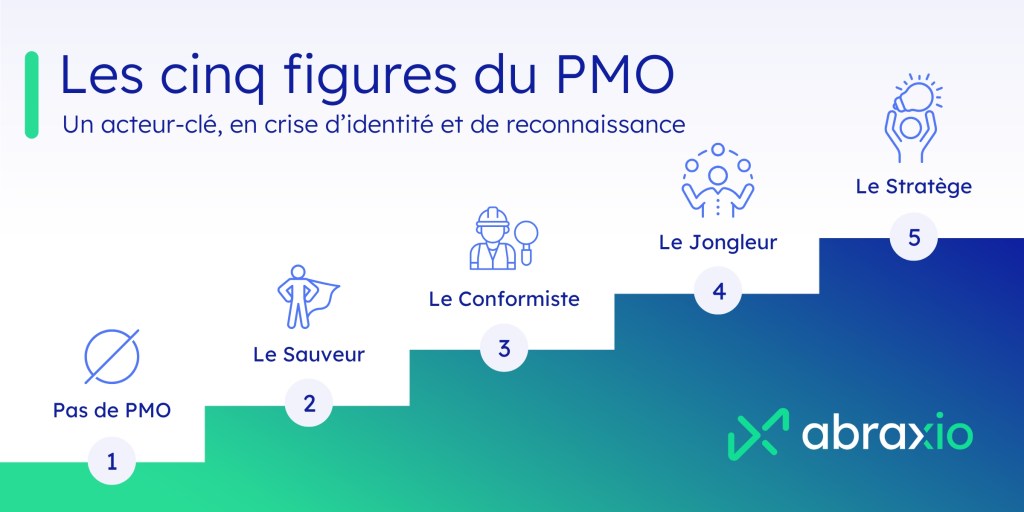
Level 3: The “PMO juggler”: Now that projects are aligned in terms of KPIs, reporting, Manage project risks, onboarding of new project managers… everything seems under control. And yet! Deadlines are still not being met, Teams are “underwater”, Budgets for Projects are not being used, while Budgets for activities are exploding. Production Teams need to be “protected” by controlling parasite requests and initiatives that have a direct impact on them.
This extension of the PMO function to include demand and capacity management is only natural. This “PMO juggler” will have to frame the initiatives by involving the business Teams: setting up request forms (and evacuating standard requests to the right Teams/tools), selection criteria, scoring, all backed by appropriate governance.
A new function, a new complexity: getting the Business Units to join forces with more than just the CIO.
Level 4. It is at this point that the PMO’s career takes a turn: either he or she remains attached to the CIO, or moves across the company to join an equivalent “transformation department” or “strategy department”. If he remains attached to the CIO, he will be criticized for his lack of objectivity. On the other hand, if he or she emerges from the CIO, he or she will have to remain pragmatic and not forget the constraints of the information system, in particular by sacralizing part of the capacity for MCO (Maintaining Operational Conditions) and compliance projects, which are all too often isolated within the CIO and ignored by the Business Units. This is what we call a “strategic PMO”.
He/she will be responsible for defining the overall governance of Projects strategy, methods and tools. In addition to monitoring these issues, he/she will be responsible for coordinating exchanges between the requesting professions, Program Directors and Projects Managers.
Of course, given the ever-increasing number of critical functions taken on by this PMO, it is evolving from a single “Officer” to an “Office”, a structure made up of several people specialized in certain PMO functions.
In conclusion, the evolution of the PMO and the proposed typology, which we hope will enable us to better analyze a complex reality and better situate the function, bear witness to the profound transformations being experienced by companies in our digital age. This transformation, rich in challenges, is paving the way for a new generation of professionals, at the crossroads of technology, strategy, Organizational change management (OCM) and transformation. From Projects management to transformation management, the path and objectives are clear and rewarding.

Nicolas Robert
– Abraxio Customer Success Director