




 Back to list

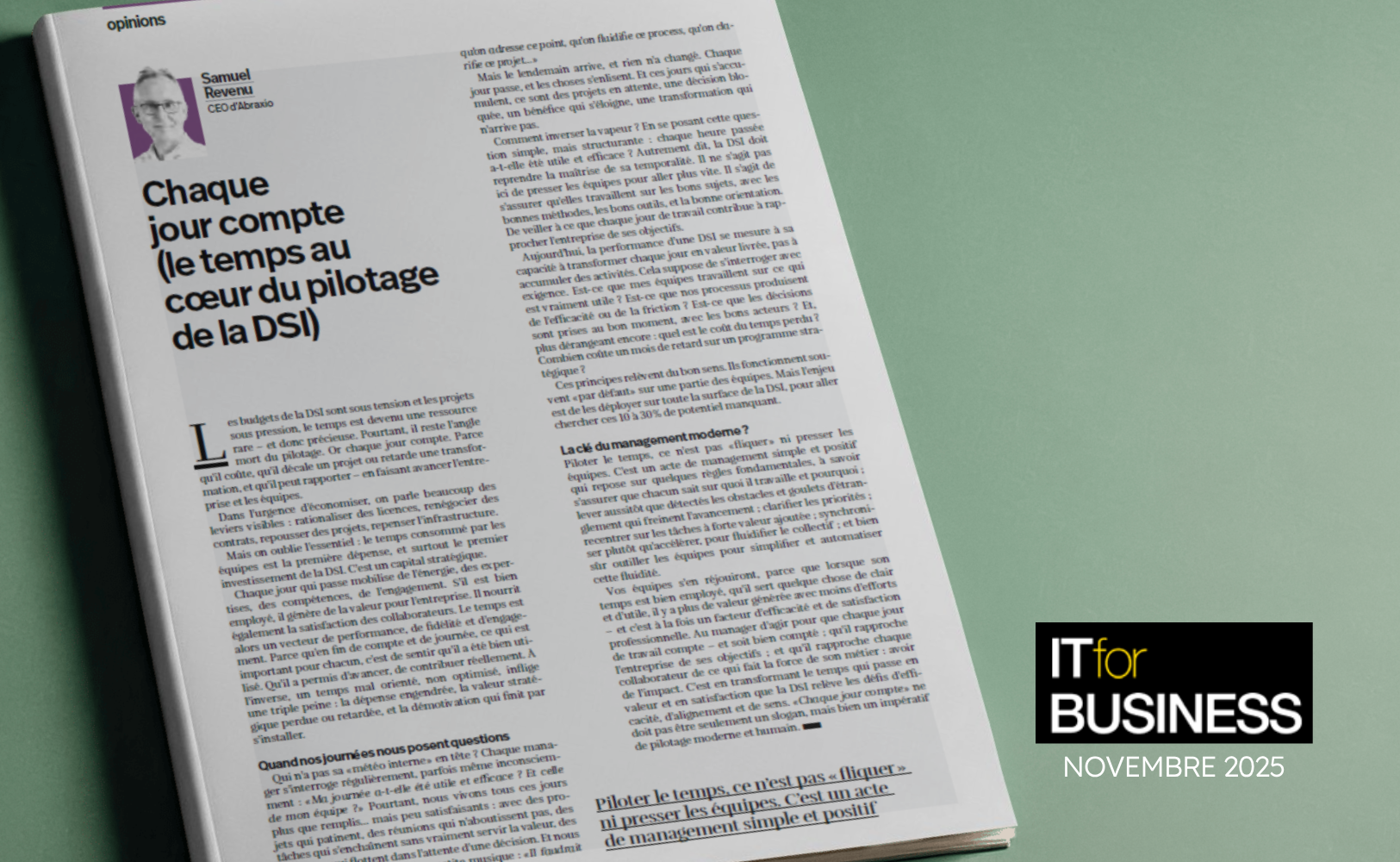
This article was originally published in ITforBusiness magazine (November 2025).
CIO Budgets are under strain and Projects are under pressure. Time has become a scarce – and therefore precious – resource. And yet, it remains the blind spot of piloting. Yet every day counts. Because it costs. Because it delays Projects and transformations. And because it can pay off – by moving the company and its Teams forward.
In the rush to save money, we talk a lot about visible levers: rationalizing licenses, renegotiating contracts, postponing Projects, rethinking infrastructure. But we forget the essential point: the time consumed by Teams is the CIO’s first expense, and above all its first investment: it’s a strategic asset.
Every day that passes mobilizes energy, expertise, Skills and commitment. If well used, it generates value for the company. It also boosts employee satisfaction. Time is a vector for performance, loyalty and commitment. Because, at the end of the day, what counts for everyone is feeling that their time has been well spent. That it has enabled them to move forward, to make a real contribution.
Conversely, time that’s poorly directed and not optimized inflicts a triple penalty: the expense involved, the strategic value lost or delayed, and the demotivation that eventually sets in.
When our days are full of questions
Who doesn’t have an “internal weather forecast” in mind? Every manager regularly asks himself or herself, sometimes even unconsciously: ” Was my day useful and effective? And my team’s? “And yet, we all live through these days that are more than full… but not very satisfying: with Projects that get bogged down, meetings that don’t come to fruition, tasks that follow on from one another without really serving their purpose, weeks that float by waiting for a decision to be made. And every evening we hear this little tune: ” We need to address this point, streamline this process, clarify this project…”.
But the next day arrives, and nothing has changed. Each day passes, and things get bogged down. And those days that pile up are projects on hold, a decision blocked, a benefit slipping away, a transformation that doesn’t happen.
How do you turn things around? By asking this simple, yet structuring question: has every hour spent been useful and effective? In other words, the CIO must regain control of its timeframe. It’s not a question of rushing Teams to move faster. It’s about making sure they’re working on the right issues, with the right methods, the right tools, and the right focus. To ensure that every working day contributes to bringing the company closer to its objectives.
Today, a CIO’s performance is measured by its ability to transform each day into delivered value, not by accumulating activities. This means asking tough questions: Are my Teams working on what is really useful? Do our processes produce efficiency or friction? Are decisions being taken at the right time, by the right people? And, even more disturbing: what is the cost of lost time? How much does a month’s delay on a strategic Program cost?
These principles are common sense. They often work “by default” on part of the Teams. But the challenge is to roll them out across the whole CIO, to tap into that missing 10-30% of potential.
The key to modern management?
Steering time doesn’t mean “flipping” or rushing Teams. It’s a simple, positive act of management based on a few fundamental rules: make sure everyone knows what they’re working on and why; remove obstacles and bottlenecks that slow progress as soon as they’re detected; clarify priorities; refocus on high value-added tasks; synchronize rather than accelerate, to make the team more fluid; and, of course, equip Teams to simplify and automate this fluidity.
Your Teams will be delighted, because when their time is well spent, serving something clear and useful, more value is generated with less effort – and that’s both a factor of efficiency and job satisfaction. It’s up to managers to ensure that every working day counts – and is well counted; that it brings the company closer to its objectives; and that it brings each employee closer to what makes his or her job so powerful: making an impact. It is by transforming the passage of time into value and satisfaction that the CIO meets the challenges of efficiency, alignment and meaning.
“Every day counts” should not just be a slogan, but an imperative for modern, humane management.

Samuel Revenu
– CEO, Abraxio