





 Back to list

Faced with growing budgetary pressures, CIOs are cautious about 2026. While IT demand remains buoyant, CIOs are anticipating tighter budgets, and expect to have to make tighter trade-offs to reconcile transformation and cost control.
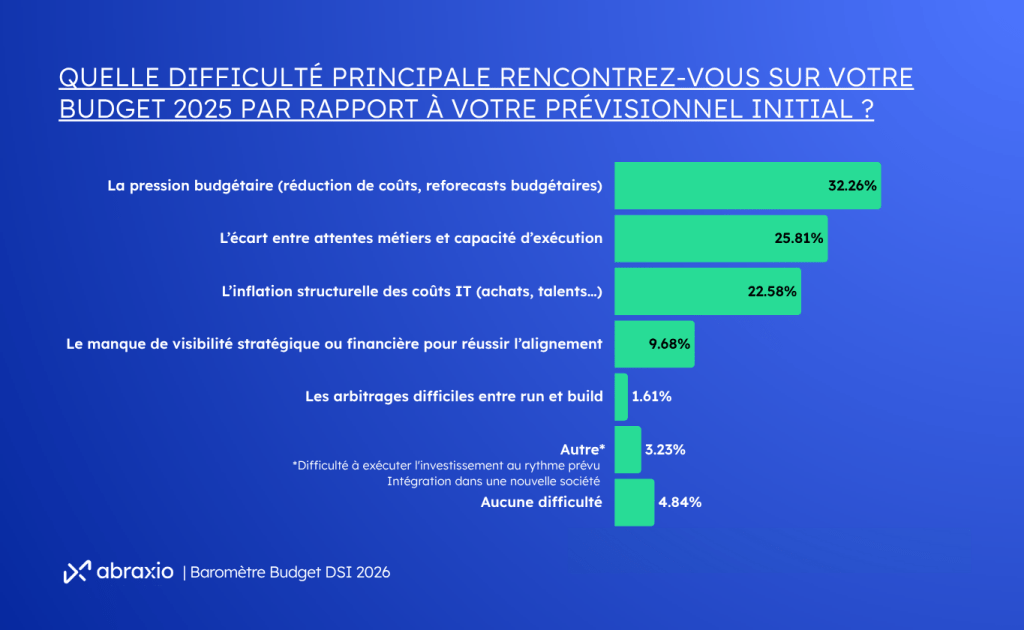
The trend is clear: halfway through 2025, Information Systems Departments (CIOs) are preparing to enter 2026 in a tense budgetary climate. According to a survey of 62 CIOs carried out in June 2025 by Abraxio, publisher of the CIO Management Platform, financial pressure now supersedes all other challenges. A third of respondents point to this constraint as their main difficulty, relegating to second place the eternal challenge of aligning business ambitions and execution capabilities, cited this year by a quarter of them.
Budgets on the decline: a break in the trend
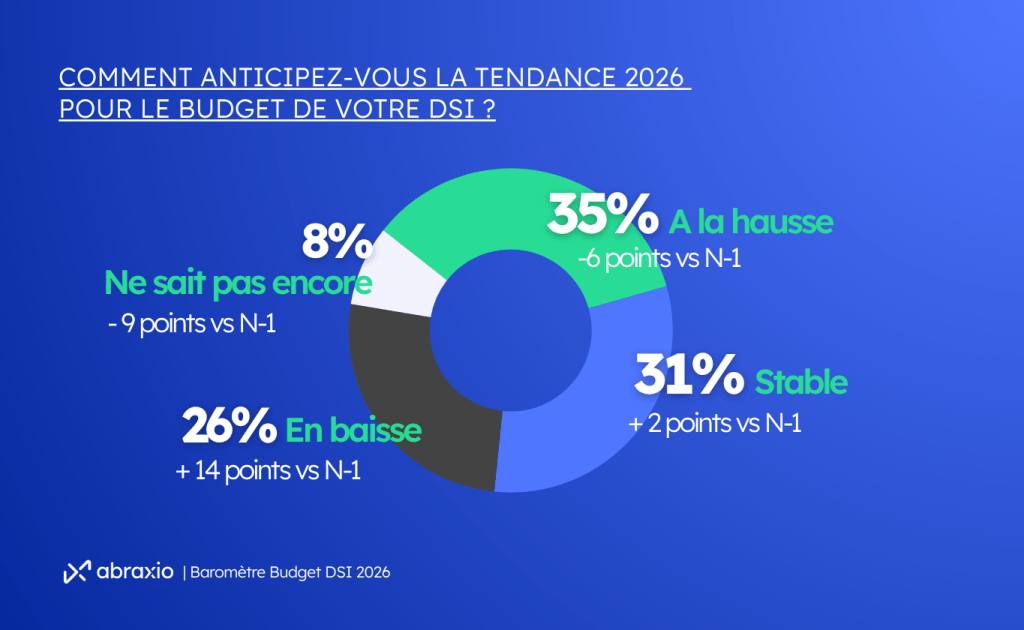
For 2026, only 35% of CIOs anticipate an increase in their Budgets – a drop of 6 points
compared to the previous year. Worse still, the proportion forecasting a decrease jumps from 12% to 26%, reflecting a clear reversal. This shift comes at a time when demand for IT remains strong, driven by the imperatives of digitalization and operational efficiency.
As for CIOs whose budgets remain stable (31%, virtually unchanged), they will nevertheless have to deal with a structural rise in IT costs. To put it plainly: a constant budget will in practice mean a shrinking budget, as there is no margin to absorb inflation or the structural rise in IT costs.
High-pressure arbitration
Budget discussions are likely to be all the more tense, with two-thirds of CIOs anticipating complex negotiations with their finance or general management – a figure that is up sharply (+18 points) on last year. Against such a backdrop of cost pressures, every budget line will have to be justified, and the strategic value of IT investments defended with precision.
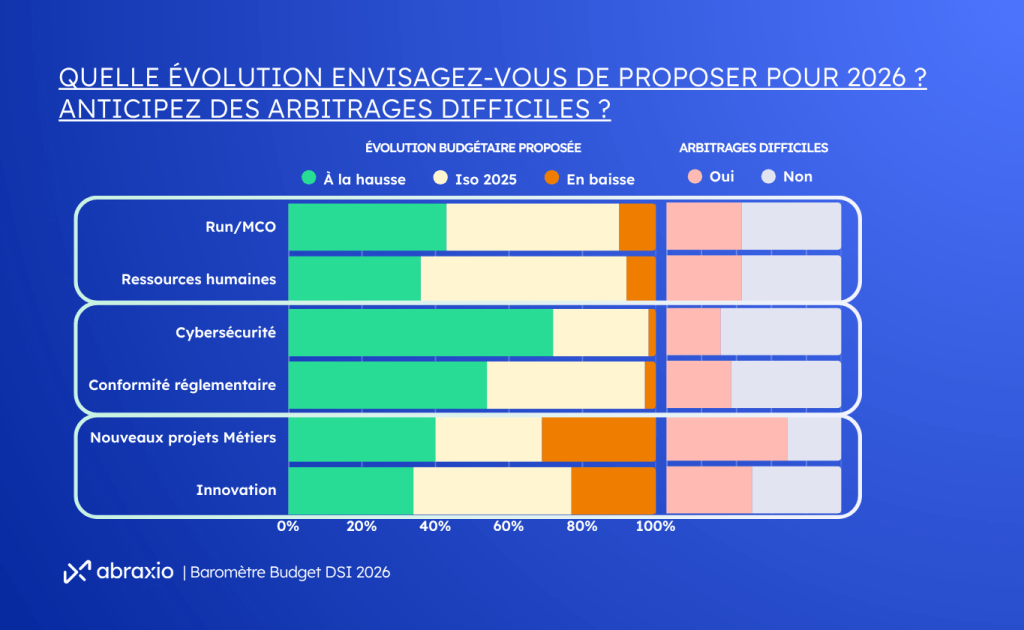
Three main trends emerge in the breakdown of expenditure forecast for 2026:
- Run and Human Resources: items considered to be incompressible and not subject to much arbitration.
- Cybersecurity and compliance: planned increases, seen as necessary and legitimate in the face of risks and regulations, and which should be even easier to pass.
- Build and innovation: the big victims of budget cuts. Despite their strategic importance, these transformational positions risk being sacrificed for lack of resources.
CIOs under multiple constraints
Three quarters of CIOs cite a triple constraint: budgetary pressure, the structural rise in IT costs and the multiplication of priorities. For many of them, the equation is becoming untenable, even with a high level of budget management maturity.
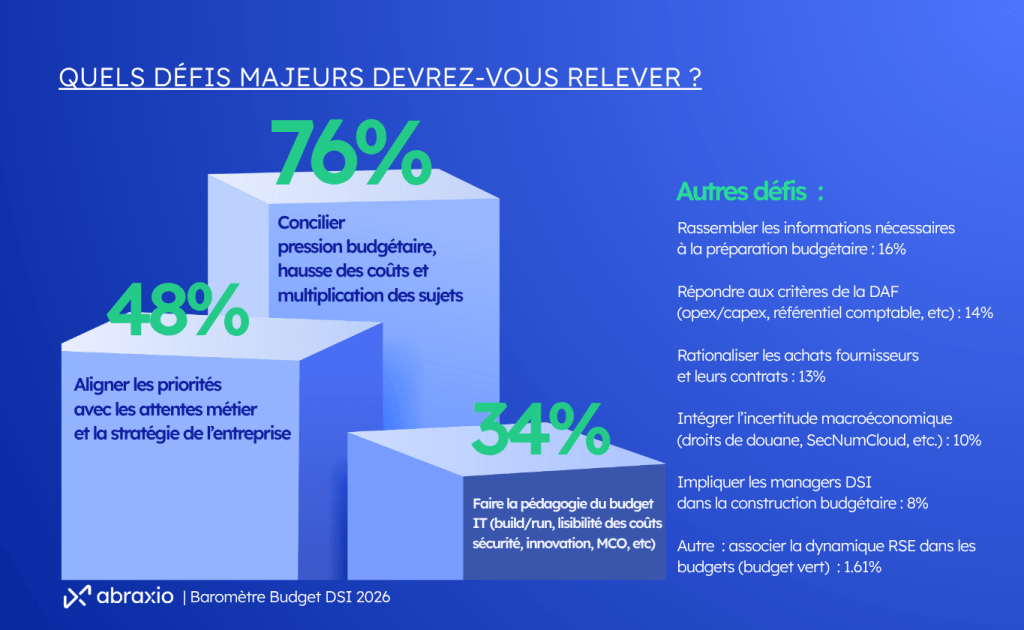
In this context, budgeting is becoming a key skill. Explaining the breakdown of expenditure (Run vs. Build, Cybersecurity, Compliance…) in a clear and comprehensible way is now essential to make the case for proposed trade-offs and protect strategic items.
A balancing act
In response to this situation, the majority of CIOs are adopting a balancing act for 2026. Even among those who will benefit from an increase in Budgets, many are opting for a cautious distribution between operational maintenance and new Projects, aware that inflation will automatically absorb a significant proportion of this budget.
” After a decade of strong growth in IT budgets, the current economic climate is forcing CIOs to rethink their priorities. Their mission has not changed: they are there to support the company’s operations and development. But in a more tense and uncertain context, they are more than ever obliged to adapt their Roadmap to the economic constraints and capacities of the organization they serve, by optimizing every operation and every cost that does not directly create value. “recommends Samuel Revenu, CEO of Abraxio.
The year 2026 promises to be a high-wire act for CIOs. Between financial stringency, rising costs and strong business expectations, the room for maneuver is shrinking. They will need to steer finely, convince effectively and arbitrate relentlessly to keep their organizations’ Digital transformation moving forward.
Resources
Further information
Contact us for access to our full CIO Budget 2026 survey, with full analysis of the results.