




 Back to list

Agility in Project management is based on iterative cycles, constant adaptation to customer needs and close collaboration within Teams. Today, several “Agility” methodological frameworks coexist. Each responds to different contexts and challenges, from the management of small software projects to large-scale industrialization. This article reviews different methods – Scrum, Kanban, Extreme Programming (XP), Crystal, DSDM, Lean – comparing their context of use, their internal organization (key roles and rituals) and their strengths and limitations.
1. What are the fundamental principles of Agility?
The Agility philosophy is based on the values of the Agile Manifesto (2001): placing working software and collaboration above documentation and contracts, responding rapidly to change rather than following a rigid plan. In concrete terms, this means dividing Projects into short, incremental iterations (sprints), delivering a partially operational end-product at the end of each iteration, and collecting customer feedback on a regular basis.
Agility Teams are self-organizing and multi-disciplinary, which means they have all the Skills they need to get the job done without external dependencies. They communicate transparently, using visual tools (Scrum or Kanban boards, backlogs, diagrams) to track progress.
The success of an Agility project rests on several pillars: close collaboration with the customer throughout development, regular rituals (sprint planning,dailyscrum, review and retrospective) to synchronize the team and adjust processes, and continuous measurement of progress using KPIs: velocity, burndown (project tracking graph), lead time (the time elapsed between the creation of a task and its completion).
For example, in a sprint (1 to 4 weeks), the team sets a clear objective and commits to a set of user stories drawn from the backlog (the list of features and tasks to be developed). This work is punctuated by: sprint planning (definition of the objective and tasks to be achieved), daily scrum (short daily progress review), sprint review (demonstration of the delivered product to stakeholders) and retrospective (analysis of the points for improvement in the past sprint). These rituals create a rapid feedback cycle and reinforce transparency between Teams, management and customers.
2. Scrum
Scrum has become the mostwidespread frameworkfor Agility software development, especially in complex Projects requiring rapid product delivery. It is particularly well-suited to projects where the customer can be provided with frequent increments, enabling feedback to be integrated.
In practice, Scrum often replaces waterfall methods when the scope evolves. On the other hand, Scrum is not recommended for extremely small Projects (1-2 people or 1-2 sprints) or for Teams that are too large without being split into sub-teams.
2.1 How is Scrum organized and what are the key rituals?
Scrum requires a small Projects team (~5-10 people) made up of three key roles: the Product Owner (business/product representative, often likened to an Agility project manager), the Scrum Master (process facilitator), and the multi-disciplinarydevelopment team. The Scrum team is self-organized and sets a sprint (short iteration of 1-4 weeks) to plan the work to be done. Rituals (“ceremonies”) structure the process:
- Sprint Planning: the team selects the backlog stories to be completed during the sprint and defines the sprint objective.
- Daily Stand-up: short daily meeting to synchronize the team (each member explains what he or she has done, will do, and what the obstacles are).
- Sprint Review (demo): at the end of the sprint, the team presents the finished product increment to the customer and stakeholders for feedback.
- Sprint Retrospective: the team analyzes its own process and identifies areas for improvement for the next sprint.
Scrum artifacts include the Product Backlog (prioritized list of tasks and features) and the Sprint Backlog (sprint goals). The Scrum Master ensures that the process is respected (organizes meetings, removes obstacles). Scrum’s clear structure and planned rituals guarantee transparency and collective responsibility. For example, management tools such as Scrum boards (digital or physical) can be used to visualize progress in real time.
2.2 What are Scrum ‘s strengths and limitations?
Scrum offers highvisibility andrapid feedback on the final product, which motivates the team and ensures customer satisfaction. Self-organization empowers team members and encourages collaboration (the Scrum Master facilitates, the Product Owner manages priorities, etc.).
On the other hand, Scrum demands rigorous discipline (keeping to sprints, producing reviews and retrospectives) and can represent a cultural shift for teams used to traditional methods. It takes time to master its concepts (short iterations, daily scrum, dedicated Scrum Master role).
What’s more, without the effective involvement of the customer or the Product Owner, priority management can become blurred.
Finally, Scrum requires a fairly complete team in terms of Skills: very small or very large teams (not split up) don’t make the most of this framework.
3. Kanban
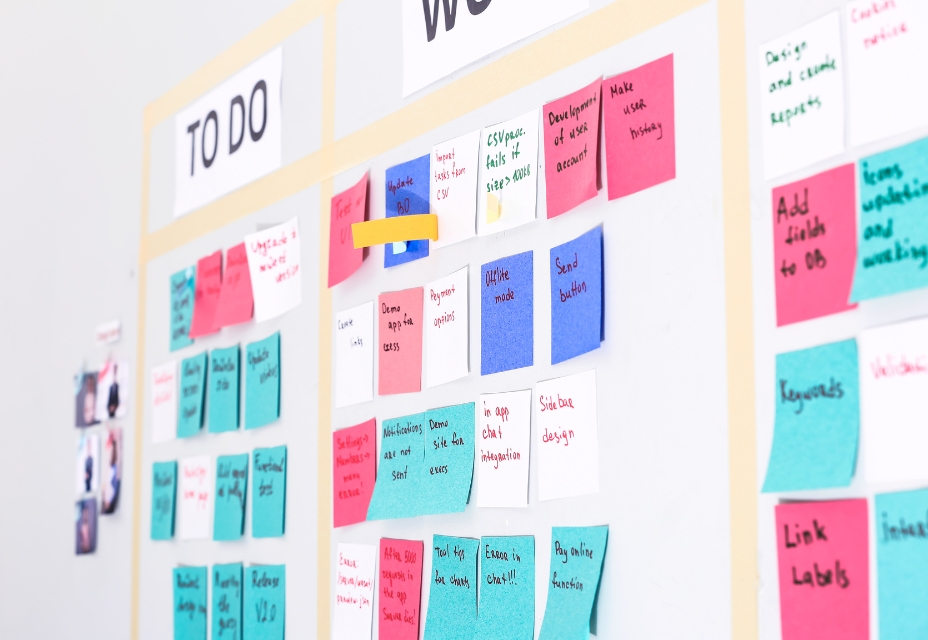
Kanban is a lightweight Agility framework, ideal for continuous-flow environments (support, maintenance, production, or even perpetual backlog development). Rather than dividing work into sprints, Kanban visualizes each task as a card on a Kanban board divided into columns (“To Do”, “In Progress”, “Completed”… as required). Teams use this board to monitor the flow of work in real time.
Kanban is particularly well suited to situations where work comes in continuously or urgently, without a fixed sprint schedule. For example, a product support team will use Kanban to process tickets as they arise. Kanban is based on transparent working and real-time communication: tasks are visually represented on a Kanban board.
3.1 What organization and key rituals for Kanban?
Unlike Scrum, Kanban doesn‘t imposefixed roles orpredefinedrhythms. Teams (often the same as in conventional mode) gather around the Kanban board: collaboration is natural and transparent (members see each other and communicate freely).
The only strict rule is to limit the WIP (work in progress ) in each column, to avoid bottlenecks. In practice, the team can organize a daily Kanban stand-up to adjust priorities and unblock sticking points.
Some add a periodic “replenishment” appointment to plan the addition of new tasks to the backlog. The main KPIs used in Kanban are:
- Lead time (total time taken to process a task, from request to delivery),
- Throughput (number of tasks completed over a given period),
- Cumulative flow chart (visual tool that shows the evolution of the number of tasks in progress, completed or to come over time).
These KPIs serve as input for a continuous improvement process.
3.2 What are Kanban ‘s strengths and limitations?
Kanban offers ahigh degree of operational flexibility: the team can change the priority of work at any time without waiting for the end of a sprint. Workflow visualization enhances collaboration and early detection of bottlenecks. Kanban is therefore ideally suited to Projects where a continuous process is managed, and delivery is “as it happens”.
However, in the absence of codified rituals, Kanban requires strong discipline to maintain WIP limits and regularly review the process. As Atlassian’s website reminds us, Kanban promotes efficiency “by orchestrating a fluid progression of tasks through visualized workflows… By limiting work-in-progress (WIP), Teams optimize Resources and maintain a smooth flow.”
One drawback, however, is thedifficulty to setprecise delivery dates (planning remains more fluid). This is why Kanban requires the team to be sufficiently autonomous and communicative: without frequent meetings (stand-ups, flow reviews), the method can lose its effectiveness.
4. Extreme Programming (XP)
Extreme Programming (XP) is an agile software development method born in the late 1990s to drastically improve code quality. It applies to small Teams (a few programmers) faced with fast-changing requirements and high technical risk.
XP emphasizes “extreme” technical practices: for example, automatic test writing (test-driven development), pair coding, code integration several times a day, and so on. It’s amethod thatfocusesoncoding and the quality of the final product, and requires constant collaboration with the customer.
Typically, an XP project will have a customer delegate available at all times to clarify requirements. XP is suitable for software Teams where the focus can be on satisfying the immediate need (we often say “You Aren’t Gonna Need It” to mean that we only develop what is needed now).
4.1 What organization and key rituals are needed for Extreme Programming?
XP doesn’t define roles as formally as Scrum, but it often includes a coach (similar to the Scrum Master) and an embedded customer. Teams meet in very short iterations (usually 1-2 weeks). Key practices include :
- Pair programming: two developers work together on the same workstation to improve quality and share knowledge.
- Automated testing and continuous integration: each function is coded with a corresponding test, and the code is regularly integrated to detect anomalies immediately.
- Continuous planning: progress is frequently discussed, but without rigid ceremonies. The backlog (or list of stories) is prioritized on a day-to-day basis, according to business value.
- Frequent deliveries: XP recommends releasing usable versions of the software every 1-2 weeks for rapid customer feedback.
The XP spirit places testing and technical flexibility on the same level as collaboration. As Kent Beck, its inventor, puts it, “XP focuses on very short cycles, automated testing and close collaboration with the customer.”
4.2 Strengths and limitations of Extreme Programming?
XP maximizes code quality and responsiveness to changes. Thanks to continuous testing and review (peer programming), bugs are caught early and the product remains maintainable. Frequent customer involvement guarantees functional adequacy. In practice, XP offers rapid feedback in the event of high risk (for example, a prototype can be delivered in one cycle).
On the other hand, XP requires a high level of human investment: pair programming virtually doubles the Headcount needed to produce the same volume of code, and demands strong collaborative Skills from developers. If the members or the customer are not available, XP can fail.
What’s more, its lack of formal rituals candisorient lessexperiencedTeams; XP requires a technical maturity (automatic testing, flexible architecture) that not all Teams naturally possess.
5. Crystal
Crystal is actually a “family” of Agility methods designed by Alistair Cockburn. The idea is to choose the Crystal variant (Clear, Yellow, Orange, Red, Maroon, Diamond, Sapphire) according toteam sizeand project criticality. For example, Crystal Clear (transparent color) applies to small, low-risk Projects (Teams ≤ 6), while Crystal Sapphire (dark color) is reserved for highly critical Projects with large Teams.
Crystal is therefore particularly well suited to adapting the process to human reality : the larger or more sensitive the team (e.g. safety-critical), the more practices and formalism the method includes.
5.1 What organization and key rituals for Crystal?
Crystal focuses on people and communication rather than rigid processes. There are no imposed standard ceremonies (no formal sprint planning, for example), but in general there are frequent deliveries (e.g. weekly or monthly depending on the size of the project), regular retrospectives, and informal coordination meetings.
Crystal Teams often work in the same space ( osmotic communication between developers, by impregnation, natural and continuous) and encourage rapid access to experts.
Cockburn identifies seven points common to all Crystal variants: frequent deliveries, continuous improvement, increased communication within the team, a climate of trust, concentration of members on their task, easy access to a business expert, and a technical environment with frequent testing and integration. These principles promote Agility by allowing the team to freely modify its process.
Formal roles in Crystal are largely unstandardized: there’s a sponsor or customer representative, developers (“Project Teams”) and sometimes a technical leader to help coordinate, but nothing as codified as the Scrum Master. The organization remains light: just the essential responsibilities are defined (who makes decisions, who validates changes, etc.), and then the team self-organizes.
5.2 What are the strengths and limitations of Crystal’s strengths and limitations?
Crystal Agility methods are highly flexible and humane, and are characterized by their low-impact approach to processes. They focus above all on communication and cooperation between project players, making them easier to deploy and flexible enough to respond to a wide variety of Project management situations. In practice, Crystalrequires little documentation, and Teams are free to adapt the framework as they see fit.
However, this flexibility has a downside: the absence of prescriptive guidance can leave an inexperienced team without clear reference points. Crystal requires team members to be mature and autonomous – there are no strict rules for managing time, Budgets or dependencies. This makes Crystal particularly suitable for teams already used to working together effectively. For highly structured or regulated Projects, its lack of formalism (“light” lifecycle) can be a drawback.
6. DSDM
DSDM (Dynamic Systems Development Method) is one of the oldest Agility methods, born in the mid-1990s in the UK. It is a comprehensive framework that covers the entire Projects lifecycle, from feasibility study to delivery and maintenance.
DSDM is particularly well-suited to large-scale Projects, including those outside the software sector, where the aim is to combine Agility with strict governance. For example, it is often used in the public sector or in large organizations, as a complement to standards such as PRINCE2.
Its modern version (DSDM Agile Project Framework) is based on eight key principles: focus on business needs, deliver on time (timeboxing), strong involvement of end-users and stakeholders, guarantee iterative and incremental development, maintain reversibility of changes, and so on.
6.1 What organization and key rituals for DSDM?
DSDM prescribes a process structured around four main phases: feasibility study, functional study, iterative design and iterative realization, followed by implementation. Each of these phases isin turnbrokendownintoshorteriterations. The DSDM project is overseen by a Steering committee and a number of clearly defined business roles (user ambassador, etc.) and technical roles (project manager, team of developers).
Rituals include rigorous checkpoints at the end of each iteration (delivery reviews, demonstrations) and iterative planning based on a fixed timebox (e.g. each iteration lasts 2 weeks). The DSDM principles also insist on continuous testing and permanent alignment with requirements. métier “.
6.2 What are the strengths and limitations of DSDM?
DSDM is robust and comprehensive: it ensures delivery of a product in line with business strategy, with transparent management of Budgets and schedules. Its clear division of responsibilities and formalization (Project charter, brief, integrated tests) are ideally suited to environments requiring a high degree of inter-team coordination. Timeboxes ensure that deliverables are delivered on time.
On the other hand, this rigor makes DSDM more cumbersome to implement than methods such as Scrum or Kanban. Its structure may seem too formal if you’re just looking for pure flexibility. DSDM often requires training for Teams and the support of a DSDM coach (to adopt the discipline). Finally, DSDM is less effective for small, non-critical Projects: the extra processes (Steering committee, documents, systematic testing) can be disproportionate if the Teams are small or the stakes are limited.
7. Lean and other agile approaches
In addition to Scrum, Kanban and XP, other similar practices can be mentioned. Lean development is inspired by Lean manufacturing: it seeks to eliminate all“waste“ (worthless tasks) and focus theteam oncreating value for the customer. The emphasis is on continuous improvement (kaizen) and reducing lead times (“time to market”). Lean doesn’t impose precise ceremonies; it’s more a state of mind to be integrated (via regular standups or Kaizen workshops, for example).
Hybrid approaches are also emerging, such as Scrumban (a mix of Scrum and Kanban) or scaled Agility frameworks (SAFe, LeSS) for coordinating multiple Teams on a single large Program. These do not replace the basic methods, but adapt Agility principles to specific contexts (large organizations, multiple dependencies, etc.). In all cases, the most important thing is to maintain close collaboration with the customer, iterate frequently, and adjust the method according to the context.
7.1 What organization and key rituals for Lean?
DSDM prescribes a process structured around four main phases: feasibility study, functional study, iterative design and iterative realization, followed by implementation. Each of these phases isin turnbrokendownintoshorteriterations. The DSDM project is overseen by a Steering committee and a number of clearly defined business roles (user ambassador, etc.) and technical roles (project manager, team of developers).
Rituals include rigorous checkpoints at the end of each iteration (delivery reviews, demonstrations) and iterative planning based on a fixed timebox (e.g. each iteration lasts 2 weeks). The DSDM principles also insist on continuous testing and permanent alignment with requirements. métier “.
7.2 What are the strengths and limitations of Lean and other Agility approaches?
DSDM is robust and comprehensive: it ensures delivery of a product in line with business strategy, with transparent management of Budgets and schedules. Its clear division of responsibilities and formalization (Project charter, brief, integrated tests) are ideally suited to environments requiring a high degree of inter-team coordination. Timeboxes ensure that deliverables are delivered on time.
On the other hand, this rigor makes DSDM more cumbersome to implement than methods such as Scrum or Kanban. Its structure may seem too formal if you’re just looking for pure flexibility. DSDM often requires training for Teams and the support of a DSDM coach (to adopt the discipline). Finally, DSDM is less effective for small, non-critical Projects: the extra processes (Steering committee, documents, systematic testing) can be disproportionate if the Teams are small or the stakes are limited.
8. Summary of advantages and limitations of Agility project management methods
| Method | Background/ uses | Key roles and rituals | Main strengths | Major limitations |
|---|---|---|---|---|
| Scrum | Complex Projects (often software) with changing needs. Allows iteration in short sprints (1-4 weeks). Projects Teams (~5-10 people) | Formal roles: Product Owner, Scrum Master, dev. team. Defined sprints with planning, daily scrum, review and retrospective | High level of transparency and adaptability (breakdown into user stories, rapid customer feedback). Motivation through frequent deliveries. Team empowerment. | Learning curve (cultural change). Requires customer/Product Owner discipline and Availability. Not ideal for very small Projects or large Teams. |
| Kanban | Work in continuous flow (support, maintenance, production, dev without fixed sprint). Allows you to improve an existing process. | No roles imposed. Kanban board with columns and WIP limits. Meetings often informal (daily stand-up) and continuous improvement via metrics (lead time, flow). | High flexibility and flow visibility. Suitable for continuous management, improves efficiency by limiting WIP. Quick to set up, with few formalities. | No fixed delivery schedule (difficult to predict fixed dates). Requires team maturity to self-organize without strict rituals. Less suited to Projects requiring a very formal structure. |
| XP (Extreme Programming) | Small software Projects (2-12 people) with volatile requirements. Focused on producing high-quality, scalable code. | No fixed roles. Key technical practices: peer programming, automated unit testing (TDD), continuous integration. Very short iterations (1-2 weeks) and constant feedback with the customer. | High code quality (continuous reviews, automated testing). Extreme responsiveness to changes (short iteration). Intense collaboration with the customer. | Cost in human resources (pair programming). Need for strong customer/user involvement. Difficult for distributed or technically immature teams. |
| Crystal | Projects of varying size and criticality (color-coded from Clear, Yellow, Orange… to Sapphire). Adapts the method to the size of the Teams and the stakes involved. | Few predefined structures. Emphasis on communication. Frequent deliveries (daily to monthly, depending on context). Regular retrospectives. | Extremely adaptable and lightweight (few formal processes). Focuses on people and collaboration. Adjusts to Teams by adjusting the “weight” of the method. | Lack of formal safeguards – depends on members’ maturity. Little imposed structure may confuse novices. Less widespread (small French-speaking community). |
| DSDM | Large-scale corporate and government projects. Full lifecycle coverage (from feasibility to maintenance). Designed to integrate Agility and governance (e.g. PRINCE2). | Very formal roles (sponsor, project manager, business/user ambassadors, etc.). Process in phases and planned iterations. Guiding principles: continuous user involvement, rigorous timeboxing, ongoing testing, priority business objectives. | Robust, predictable framework for large Projects. Ensures business delivery through short timeboxes and customer collaboration. Rigorous steer of budgets and deadlines. | High complexity and cost of implementation. Cumbersome documentation and processes (committees, reports). Less flexible for small Projects or Teams. |
| Lean | Flow and efficiency-oriented context (manufacturing, startups), any team seeking to eliminate waste | Focus on customer value Elimination of unnecessary tasks Kaizen workshops, continuous improvement (no fixed ceremonies) | Reduced lead times and costs Culture of efficiency and quality | Very generalist (few operational managers) Less focus on iterative delivery aspects |
9. How to choose and implement the right method?
The choice of Agile methodology depends above all on the project context and the maturity of the team. For a classic digital project with features to be developed and frequent user requests, Scrum is often a good starting point, as it immediately provides a comprehensive framework.
On the other hand, for a maintenance or support team (continuous flow of tickets) or a department already in place, Kanban may be more appropriate , as it adapts gradually without radical structural change. XP is relevant when the main issue is code quality (e.g. mission-critical systems, banking applications) and the team is ready to commit to its practices.
The important thing is to remain true to Agility values: close collaboration with the customer, total transparency on the part of the team, and a willingness to adjust processes through retrospectives. An Agile methodology is not set in stone: over the course of iterations, the team will need to fine-tune its rituals and tools to maximize efficiency.
Conclusion
Each agile method responds to specific needs: Scrum facilitates the management of complex projects in iterative cycles, Kanban optimizes continuous workflows, XP aims for technical excellence in a development context, Crystal adapts levity to team size, and DSDM offers a comprehensive framework for large-scale Teams.
The choice of Agile methodology should be based on corporate culture, project team size and customer requirements. Often, organizations combine practices (for example, a Kanban board for Tracking in a Scrum project) to get the best out of each approach.
Whatever the method, the core of Agility remains the same: to rapidly deliver added value to the customer thanks to the continuous collaboration and adaptability of our Teams.