





 Back to list

CIOs self-assess their steering maturity and identify areas for improvement
January 20, 2025
103/200 (1) is the score given by CIOs for the maturity of their IT department steering in the Abraxio 2025 Barometer. These very modest results testify to the profession’s demands on its practices. This study, based on the self-assessment of 92 CIOs of various sizes(2) and from different sectors, highlights a profession at a crossroads, determined to develop its role within organizations.
Far from kidding themselves, CIOs demonstrate a remarkable capacity for self-criticism and forward-looking analysis. Their average score of 103/200 – just shy of the average – reflects a collective awareness of the room for improvement needed to bring their management systems to greater maturity. The outlook is nonetheless encouraging, since concrete levers for improvement have been identified: from financial management to Projects management, from governance to Resources and suppliers, the Barometer covers a broad panorama, with no fewer than 70 items surveyed, grouped into 7 pillars. Among them, the “performance” criterion is a priority subject on which 91% of CIOs would like to make progress.
Governance: The paradox of CIOs, supported by management but poorly understood by business lines
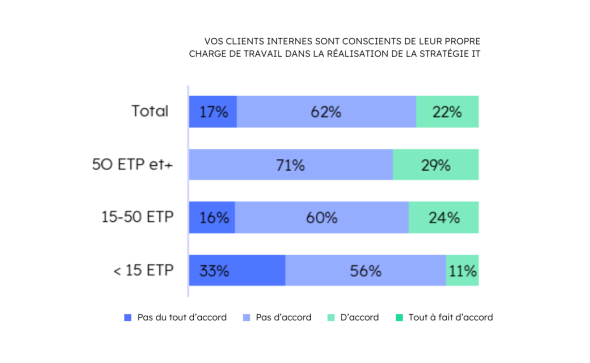
The good news is that 78% of CIOs consider themselves to be a key partner of General Management, and receive active support from top management who increasingly recognize their value. At the other end of the scale, however, CIOs suffer from a lack of understanding on the part of other company departments: only 22% of CIOs consider that their internal customers really measure their own workload in implementing IT strategy (in other words, the time that business departments have to devote to CIO projects). This figure drops to 11% in smaller CIOs. The solution to improving proximity with the Business Units and their Teams: strengthen dialogue and collaboration, with the aim of being seen as an ally and partner, at all levels of the company.
Project portfolios and project management: trade-offs to be co-managed with business units
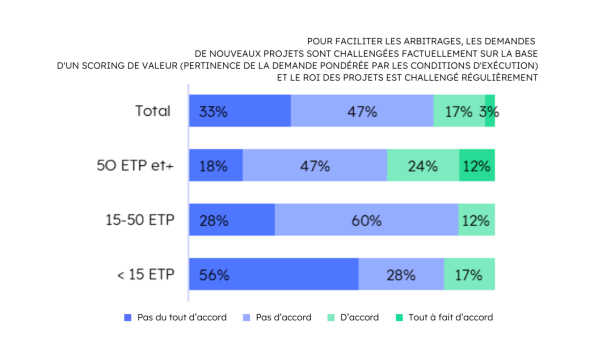
This situation of insufficient collaboration between CIOs and Business Units is illustrated in concrete terms by the way in which project portfolios are managed: while 77% of CIOs feel that their project portfolio is correctly aligned with the organization’s overall strategy, the scoring of project value and the ROI challenge remain neglected, with only 20% of CIOs having recourse to them. As a result, 45% of CIOs assume sole responsibility for arbitration.
This shows the importance of setting up coordination committees to collectively arbitrate scoring requests, for better management of the Projects portfolio and schedules.
Financial management: budget tracking is still tedious
Budgets are a key concern for CIOs. Yet only 58% of CIOs feel able to identify budget drift and cost optimization levers within their Budgets. (and only 53% of large CIOs). Budget preparation, daily tracking, reforecasts…: automation is a major area of progress for CIOs. Only 42% of them claim to have reduced the “tediousness” of their budget tracking by automating its management as much as possible. For large CIOs (50 or more FTEs), this figure drops to 30%, no doubt due to the complexity of their Budgets and the heavier impact of consolidation than elsewhere.
Delegation and centralization: the dual challenge facing CIOs
Still on the subject of Budgets, CIOs find it hard to delegate budget responsibilities to their Teams, with only 50% succeeding in doing so. This reluctance raises questions as much about the managerial or cultural obstacles at play as about the difficulty of overcoming tooling issues. Further complicating matters is the fact that 72% of CIOs find it difficult to disperse management data across a variety of solutions. What’s more, only 25% of CIOs have set up a CIO Office to centralize and consolidate IT department activity reporting, revealing untapped potential in structuring IT department steering, to bring out new roles and responsibilities and thus relieve the CIO.
Harmonizing practices is also a key concern for CIOs:
- Only 45% of Projects managers share common methodologies
- 47% of CIOs centralize their Project management in a single tool, which limits reporting.
- The function of PMO remains rare, present in only 38% of CIOs as Project portfolio steerer.
This Barometer provides a comprehensive overview of the challenges facing any CIO considering a more mature, high-performance approach to IT department steering. The results are certainly demanding, but above all they bear witness to a very positive dynamic: that of a profession that is lucid, ambitious and resolutely focused on transformation”, analyses Samuel Revenu, CEO of Abraxio. “To reinforce this steering, it’s up to each CIO, depending on its own context, to define its priorities and focus its efforts on the most critical areas or those generating the greatest impact. In any case, there are many concrete avenues to be pursued to unleash the full potential of CIOs.
Methodology :
Data collected from October 14 to November 11, 2024 from 92 respondents.
Abraxio has chosen to assess the maturity of its steering through the prism of 7 criteria: strategy and organization / budget and financial steering / portfolio and project management / suppliers / teams and human resources / performance / leadership and position of the CIO.
To measure progress against these criteria, Abraxio identified 10 questions for each of them, for a total of 70 items on which each respondent was asked to position himself, by assessing the current situation of his CIO at the time of the survey.
About Abraxio
Abraxio is the benchmark platform for managing, steering and leveraging the impact of Information Systems Departments (CIOs). A 100% affinity solution developed by former CIOs for CIOs of SMEs, ETIs and public institutions and their teams, Abraxio simplifies their day-to-day work and empowers them to be efficient, Agile and collaborative, by enabling them to manage all aspects of their business in real time: Budgets, Projects, Teams, Suppliers.
A fast-growing Lyon-based start-up, the company had over 30 employees by early 2025, and supports 400 CIOs from all types of companies and business sectors, representing over 7,000 daily users of its platform.